

Round 2 MBA Application Countdown: Check, Choose, and Commit
Confirm each program’s test policy, select the GMAT/GRE/EA (or a waiver), book a test date, and then build a focused study plan so Round 2 stays calm, not chaotic.


In this Substack exclusive 35-second video, Stratus Director of MBA Admissions Susan Cera shares how to decide test versus waiver, verify each program’s requirements, select and schedule the GMAT/GRE/EA, take the TOEFL (if required), and keep your prep focused.
What You Should Be Doing This Week to Prepare for Round 2
As Round 1 winds down, many applicants are catching their breath—or anxiously refreshing their inboxes for interview invites. If you’re aiming for Round 2, October is your friend. Used well, the next few weeks can elevate your candidacy and reduce application-related stress. And remember: choosing to apply in Round 2 isn’t a consolation prize. Submitting a thoughtful, polished application in January is far better than rushing a “good enough” version now. Aim for a smooth, controlled landing—not a crash.
Create a Test Plan
If you already have a GMAT/GRE score you’re proud of, great! Move on. If not, make testing your October priority:
Check policies first. Confirm whether each target program requires a test or offers waivers (and whether any English-proficiency test such as TOEFL/IELTS is needed).
Decide your path. If you’ll apply without submitting a test score (at schools with a test-optional policy), redirect your time to strengthening academics (e.g., taking a quant class), fine-tuning your resume for maximum impact, and polishing your essays. If you’ll submit a score, choose the exam that best fits your strengths (GMAT, GRE, or EA) and book a test date that leaves a retake buffer.
Study with intent. Take a diagnostic test, set a realistic target range for your schools, and build a weekly plan focused on your weak areas. Use official practice tests, track your accuracy and timing, and review your errors—not just your scores.
Mind the logistics. Confirm test center ID requirements and testing location/device rules, and taper your studying in the final 72 hours so you arrive rested and ready.
Senior MBA Admissions Counselor Donna Bauman’s Tips on Choosing Your MBA Admissions Test
Take a Test Drive
If you’re unsure which exam fits you best, take full-length practice tests for both the GMAT and the GRE. Often, the choice becomes clear once you see which test better showcases your quantitative and verbal strengths. Then, talk it through with an experienced prep coach. The experts at GMAT Ninja offer practical guidance and free resources tailored to the GMAT.
Charles Bibilos, GMAT Ninja founder, offers this advice:
“Preparing for the current version of the GMAT is arguably a good way to get yourself ready for MBA coursework. However, the current version of the GMAT has eight different question types spread across three different sections. The GRE covers less ground than the GMAT, so a lot of test-takers—especially people who struggle with quant—prefer the GRE because it usually requires less studying, and doesn’t feel nearly as intimidating. If an applicant wants to show schools that they’re an academic rockstar, I usually encourage them to take the GMAT, even if it requires more studying.”
If you’re still struggling with both the GMAT and the GRE, consider taking the EA.
If You Don’t Test Well
If you’re not comfortable with your scores on any of the practice tests, target MBA programs that offer test waivers and submit a compelling request with evidence of your quantitative readiness (e.g., transcripts, certifications, on-the-job analytics, or recent quant coursework).
The Bottom Line
Admissions teams don’t care which of their accepted tests you take; they care that you’re ready for the quant rigor and that your application reflects your best work. Choose the exam that amplifies your strengths. And if testing isn’t your superpower, pursue a waiver strategy backed by strong proof of your academic or professional capabilities.
MBA Admissions Episode 5: When Is a Low GMAT Score Really the Apocalypse?
Watch this episode now on the GMAT Ninja YouTube channel!
Stratus Director of MBA Admissions Susan Cera, Stratus Senior MBA Admissions Counselor Donna Bauman, and GMAT Ninja Founder Charles Bibilos cut through the noise on how admissions teams actually view GMAT, GRE, and EA scores. Drawing on a combined 60+ years in the field, they offer clear, candid guidance on when scores help, when they hurt, and what to do next.
This episode covers the following scenarios:
If you’re in a crowded demographic (e.g., Indian male engineer), is a 700 GMAT score competitive at top programs?
If you’re from a less represented background (e.g., a woman from a nontraditional path), can you be viable with a 650?
How do you offset a weak quant profile, and what evidence do admissions committees actually value?
What are smart moves to make (e.g., targets, scholarships, alternatives) if applying to the top ten schools isn’t panning out?
MBA Applicant Profile Review
Each week, a Stratus consultant reviews an anonymous MBA applicant’s profile and shares their expert recommendation, drawing on years of admissions experience.

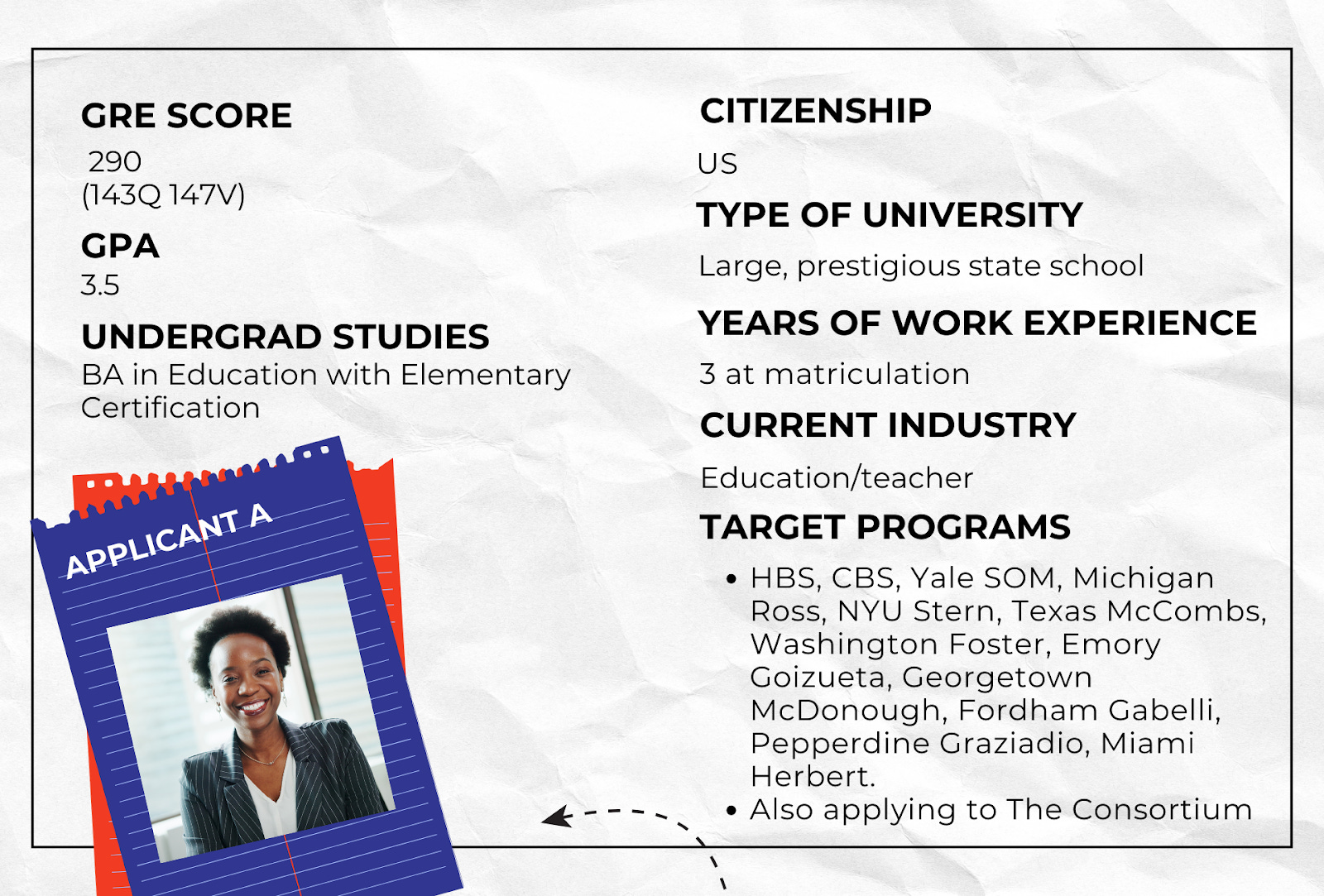
GRE/GMAT/EA Score 290 GRE (143Q, 147V)
GPA: 3.5
Undergraduate Major: BA in Education with Elementary Certification
Type of University: Large, prestigious state school
Current Industry: Education/teacher
Years of Work Experience at Matriculation: 3 years
Target Programs: Mix of super stretch, stretch, and likely:
HBS, CBS, Yale SOM, Michigan Ross, NYU Stern, Texas McCombs, Washington Foster, Emory Goizueta, Georgetown McDonough, Fordham Gabelli, Pepperdine Graziadio, Miami Herbert
Also applying to The Consortium
Citizenship: US
About
Despite receiving childhood diagnoses of dyslexia and ADHD, and later coping with her mother’s illness and death, this candidate achieved academic success and earned a 3.5 GPA in college.
While her GPA is strong, she did not take many quant classes that showed her aptitude. But she did receive a B in statistics and performed well in courses about teaching elementary-level math.
Because of her learning differences, the applicant has not been a strong standardized test taker—hence the 290 GRE.
After seeing that teaching resources were lacking, she created an EdTech product to address resource gaps—in part to help make the resources available to all socioeconomic groups.
The candidate has been teaching predominantly underserved and underrepresented minority populations, and she wants to address resource gaps for these vulnerable groups with not only her product but also other resources.
She volunteered to manage her school’s social media platforms to help improve enrollment, leading to a significant increase in enrollment and funding.
Post-MBA goals:
Short term: Become a product marketing manager for an EdTech company like Google for Education, Newsela, or Amazon K12
Long term: Start her own consulting firm and help districts market their schools and products
Joe’s Advice
MBA programs love to have students representing various industries and backgrounds, so having a teacher in the ranks who can speak about policy-level issues as well as product and resource gaps would enhance any MBA class. This candidate is capable of excelling in an MBA program even if her current GRE score does not prove that outright. Her undergrad performance (especially during the harrowing circumstances surrounding her mother’s illness) and her career performance demonstrate that she can handle the academics. However, teachers do not always have much exposure to business fundamentals, which she will have to address in her application.
I suggest that this candidate work with a tutor to help improve her GRE score and at least get closer to the middle 80% range for her target schools. In addition, I recommend that she also take a quantitative course (e.g., MBA Math, UC Berkeley Extension “Math for Management,” HBS CORe) to shore up these skills. The applicant has already completed additional learning by taking LinkedIn courses and product courses to teach herself how to start her company, so her zeal for learning is palpable and something she can lean further on.
I also suggest that she lean into the launch of her new company, showing all the business skills she is already learning on the job. Doing so will help prove that this candidate is not lacking business acumen and will help overcome the possible perception that teachers lack these skills. She should also highlight the marketing work she has done for her school and the impact she made to further demonstrate business skills (marketing in particular). The launch of a product, her initiative to volunteer to market her school, and teaching the underserved all demonstrate leadership across different dimensions, and she should show the scale of her impact (as she did with the metrics on increased enrollment and funding at her school).
As someone who will be a bit younger upon matriculation, this applicant will need to explain “Why now?” in her application. She is concerned about the lack of resources for education students, and so she can focus on how she sees this as an urgent need that she cannot wait to address. She can also explain that she has already grown as far as she can in the educational system and therefore needs the business fundamentals an MBA can provide to enable her to pivot into solving the problems in the private sector.
This candidate’s short-term goal is rational and achievable, though her long-term goal is not necessarily a new idea and may be an endeavor that already exists. Consequently, she could reframe this as “building a consultancy that bridges EdTech companies and underserved districts” or alternatively consider running product marketing for a newer firm to accomplish the same goal. She may also wish to lean more into her EdTech startup in the context of expanding her EdTech venture into a scalable platform. She could even frame using entrepreneurial labs in business school to help her scale and grow this venture. Furthermore, this applicant should demonstrate her knowledge of current EdTech market dynamics (such as how large players partner with districts, or equity gaps in digital adoption) to make her career vision more credible.
Her list of target schools includes a good spread of aspirational and more likely programs. If she cannot improve her GRE score, then she should consider additional likely schools such as Vanderbilt Owen, Rice Jones, UNC Kenan-Flagler, Rochester Simon, or Indiana Kelley.