

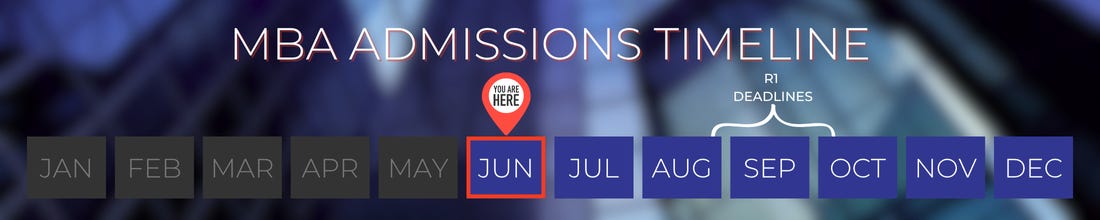
Approximately 90 Days Until Round 1 Deadlines!
With the first Round 1 deadlines approaching in late August and early September, you have fewer than 90 days to craft your strongest application.

What You Should Be Doing in June to Prepare for Round 1
1. Determine which standardized test suits you best—and take it!
June is an ideal time to take your first exam if you haven’t already. Testing now allows you ample time to evaluate your performance and retake if needed—without the pressure of looming Round 1 application deadlines. Keep in mind that there are mandatory wait periods between retakes, so plan accordingly!
If you’re unsure about which test suits you best, try taking practice exams for both the GMAT and the GRE. Your results will likely reveal which one showcases your strengths more effectively, helping you make a confident decision. If you find you are still struggling with both the GMAT and the GRE, consider taking the EA. If none of the MBA testing options showcase your strengths, target MBA programs that offer a test waiver.
As a former admissions reviewer, Stratus Senior MBA Admissions Counselor Donna Bauman would rather see a strong GRE score than a lower GMAT score. If she saw neither of those, she would look for a strong EA score or other compelling evidence of quantitative prowess submitted through a test waiver request. It’s that simple—and maybe that’s the answer to the question of which is the best test to take.
PRO TIP: GMAT Ninja provides great free resources on preparing for the newest GMAT option.
2. Assess your GMAT/GRE/EA score.
Are you confident in your current standardized test score?
Have you taken practice GMAT, GRE, or EA exams to determine which test best suits you?
Do you have a plan in place in case you need to retest?
Exclusive Stratus video featuring Stratus Senior MBA Counselor Jennifer Jackson
3. Learn more about test waivers.
Not all test waiver requests are approved, and each school evaluates them differently. You’ll need to demonstrate strong undergraduate performance, professional quantitative experience, graduate-level coursework, and other academic credentials to justify a waiver, and outcomes may vary across programs. While approval from one school may indicate a good chance of approval elsewhere, it’s not guaranteed. Schools may require specific information for waiver requests or provide a brief open-ended field for your explanation. Visit each school’s website to learn more about its process for requesting a test waiver.
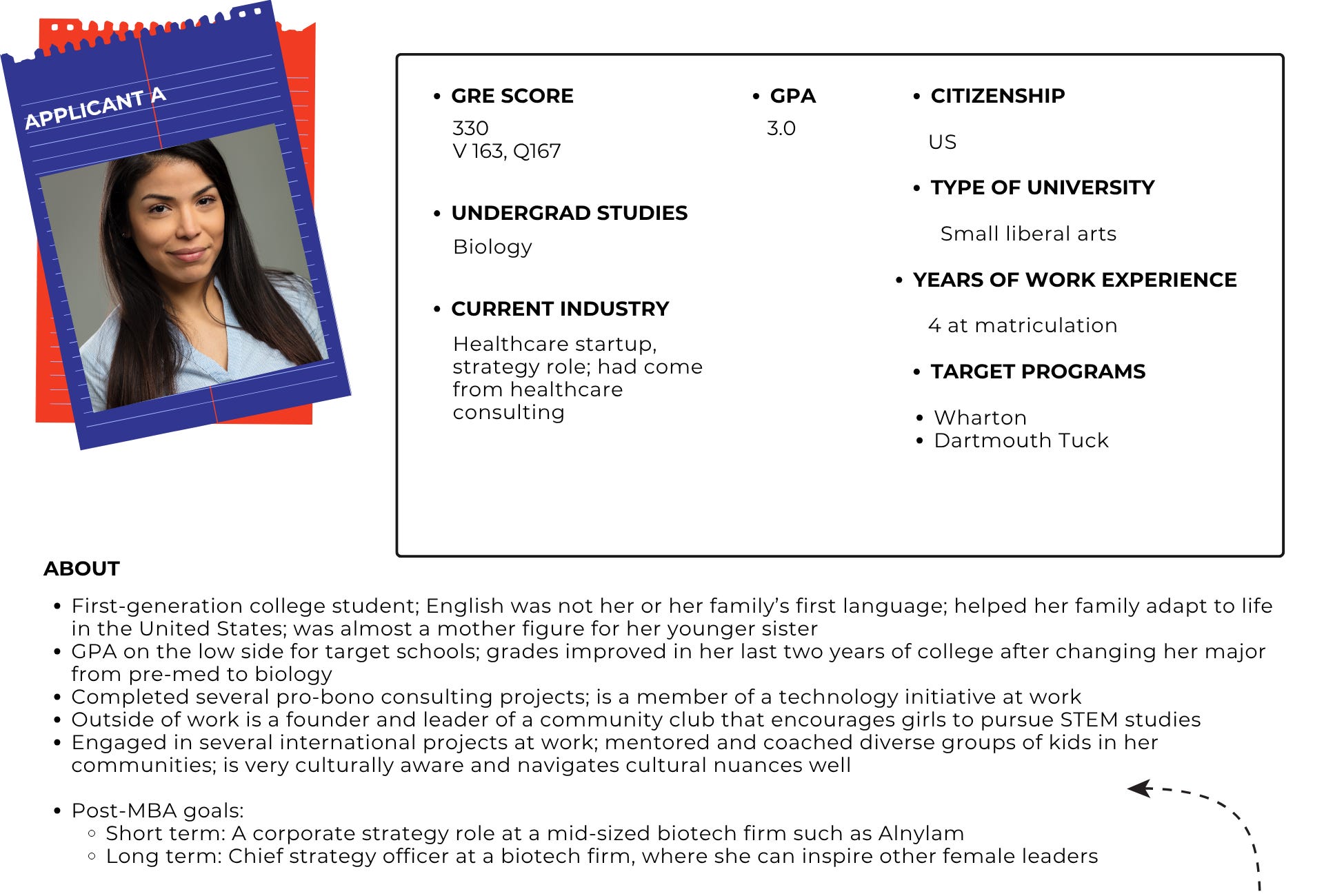
MBA Applicant Profile Review
Each week, a Stratus consultant will review an anonymous MBA applicant’s profile and share their expert recommendation, drawing on years of admissions experience.

Lisa’s Advice
This candidate is concerned about her lower GPA for her target schools, mostly M7. She went into college intending to be a pre-med major—as her family had suffered as a result of poor medical care—but then she changed her mind, aiming for roles where she could help improve diagnostic tools and risk assessment. Unfortunately, those pre-med classes pulled down her GPA. Therefore, I suggest that the candidate highlight the improvement in her GPA when pre-med classes were not in her curriculum and that she also present her higher “alternative” 3.6 GPA from just her third and fourth years, as long as she is clear about how she derived it. That number is closer to the averages of her target programs. Additionally, I recommend that the candidate take a stats or calc course online so she can get a letter grade to demonstrate her quant readiness to her target schools. I also suggest that she explain her lower GPA in the optional application essay.
This candidate has a really strong leadership and volunteering record at work and in her community, which she had downplayed in our conversations. She has focused on mentoring young girls and encourages them to pursue studies in STEM. These are solid and important skills to highlight, so I suggest that she stress those activities; they will make her profile stand out and are tasks she could continue as an MBA student. Additionally, she can talk about her responsibilities with helping her family, which started when they emigrated to the United States when she was a child and continue today. Finally, this candidate also assumed that most applicants have her high level of cultural awareness and ability to work cross-culturally, but this is another distinguishing characteristic that will help her application pop.
While she has relevant experience, she needs more financial acumen and strategy insight as well as knowledge of the biotech and pharma industries to reach her goals. The applicant is interested in Wharton and Dartmouth Tuck for their health-care focus; I also suggest that she consider Northwestern Kellogg, UNC Kenan-Flagler, Duke Fuqua, and Michigan Ross—all of which have strong health-care offerings.

Podcast Recommendation: Think Fast, Talk Smart with Matt Abrahams from Stanford GSB
From Susan Cera, Stratus Director of MBA Admissions:
Each week, Matt and his guests—many of whom are business school professors—share insights on how communication can allow you to build trust, motivate others, negotiate, and more! I find myself leaning into these tips and techniques when working with clients to uncover and craft their narratives for business school applications.
In Summary
You’ve got fewer than 90 days until Round 1 MBA deadlines! June is the time to lock in your test strategy and start shaping a standout application.
Choose your best-fit test (GMAT, GRE, or EA) by reviewing practice scores—and plan now for retakes if needed.
Start working on your story and essays. Early prep gives you time for reflection, revision, and expert feedback.
Consider test waivers wisely. They’re not guaranteed, so make sure your academic and professional profiles are strong.
Follow our weekly applicant profile reviews for insights into how real candidates can position themselves more effectively.
Listen and learn! We recommend checking out the Think Fast, Talk Smart podcast to sharpen your communication and storytelling skills.
Next week, we’ll bring you more essential to-dos and tools to keep your Round 1 MBA applications on track.